
Emergency Tax Ireland | How to Stop It, Claim Your Refund, and Never Lose Your Full Salary Again
If you have just received your first Irish payslip and the number looks nothing like what you were expecting, you have almost certainly been hit with emergency tax ireland — and you are not alone. Emergency tax ireland happens to nearly every internationally trained doctor, nurse, engineer, and skilled professional who arrives here on a Critical Skills or General Employment Permit and starts work before fully registering with Revenue.
The good news is that emergency tax ireland is completely fixable, every euro taken above your proper tax liability will come back to you, and this guide gives you the exact steps to make that happen — without guesswork and without waiting on hold with Revenue for hours.
- What is Emergency Tax and Why Does it Happen?
- How Much Extra Are You Actually Losing?
- How to Stop Emergency Tax — Step by Step
- How to Get Your Emergency Tax Refund
- Emergency Tax Refund Estimator
- Revenue Emergency Tax Phone Number and Contact Options
- How to Avoid Emergency Tax When Starting a New Job
- Frequently Asked Questions
What is Emergency Tax? | Why Revenue Hits New Arrivals So Hard
Emergency tax ireland is a temporary, punishing deduction that the Irish Revenue Commissioners apply automatically to your salary when your employer cannot link your PPSN and tax registration to a valid tax credit certificate, Revenue has no instruction on how much to deduct , so it defaults to the most aggressive option available.
In practice this means for the first four weeks of employment you are taxed at the standard 20% rate but with zero tax credits applied. From week five onwards, if the situation is still unresolved, Revenue escalates to a flat 40% deduction on all income — regardless of how much you earn. If your employer cannot confirm you hold a valid Irish PPS number at all, the rate goes to 40% from day one.
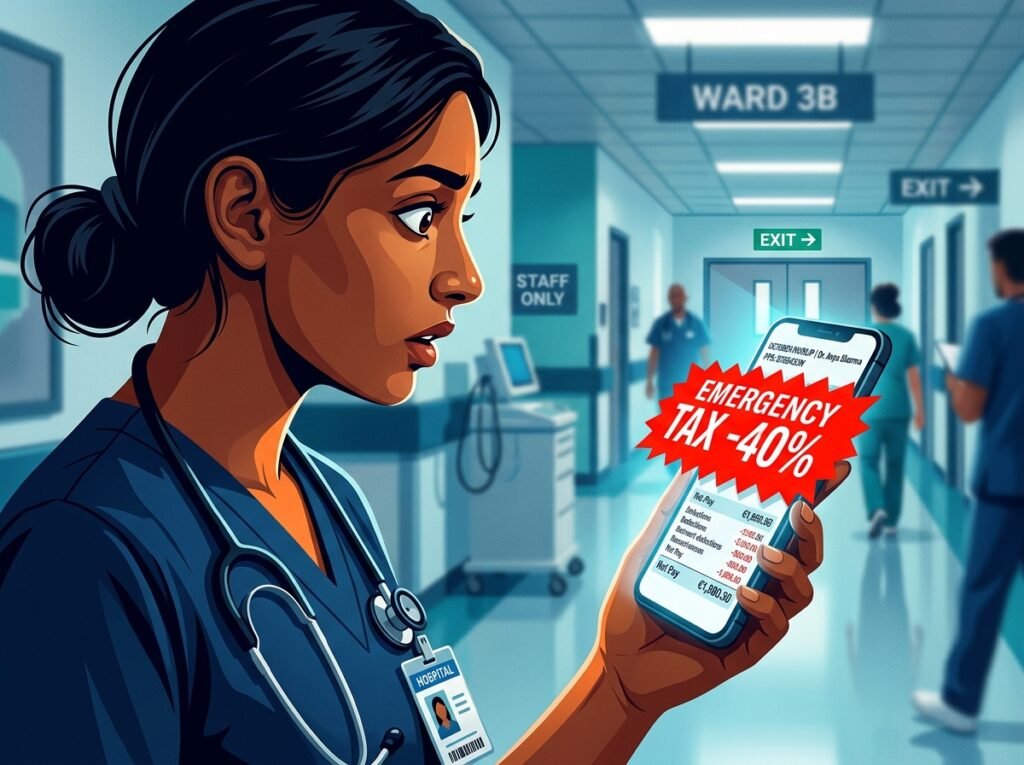
For an international doctor expecting to see their full salary reflected in the HSE pay scale figures or a nurse who has carefully calculated their take-home against the 2026 Irish salary guides, that first payslip is genuinely alarming. A gross monthly salary of €4,500 can become a net of €2,700 under emergency tax conditions — and that shortfall compounds every month until you resolve it.
How Much Does Emergency Tax Ireland Actually Cost You Each Month?
The difference between your proper tax liability and what emergency tax deducts is the amount sitting in Revenue's hands waiting for you to claim it back. For most internationally trained professionals in Ireland, this gap runs between €400 and €900 per month — and it accumulates silently until you act.
Your proper tax position combines your Personal Tax Credit (€2,000 in 2026), your Employee Tax Credit (€2,000), and the standard rate band (20% on the first €44,000 of annual income). Emergency tax strips away every credit and in its worst form applies 40% across the board. The mathematical difference between those two positions is your refund.
How to Stop Emergency Tax Ireland | The Exact Steps in 2026
Getting off emergency tax requires you to formally register as a new employee with Revenue and trigger the issue of a Revenue Payroll Notification (RPN) to your employer. Once your employer's payroll system receives that RPN, it switches automatically to your correct tax position from the next pay run. Here is exactly how to do it.
Step 1 — Get Your PPSN If You Do Not Already Have One
Your PPS number is the foundation of your entire Irish tax and social welfare identity. Without it, Revenue cannot register you and your employer cannot process your pay correctly. If you arrived on a work permit and do not yet have a PPSN, apply at your local Intreo Centre or online — the Department of Social Protection's PPSN application guide is at gov.ie — apply for a PPSN.
Processing typically takes three to five working days. Do not wait for your PPSN before starting the rest of this process — begin everything else in parallel so you lose as little time as possible.
Step 2 — Register for myAccount on Revenue.ie
Go to revenue.ie — register as a new employee and create a myAccount login. You will need your PPSN, your date of birth, your Irish mobile number, and your Irish address. The registration sends a verification code to your mobile — complete the process and log in.
myAccount is Revenue's self-service portal. It is where you will register your employment, claim your tax credits, submit your flat-rate expense claim, and view your tax credit certificate — all in one place. You can access it directly at myaccount.revenue.ie without ever needing to speak to anyone.
Step 3 — Register Your New Employment
Inside myAccount, navigate to the PAYE Services section and select "Update Job or Pension." Add your new employer using their registered name or tax registration number (your HR department can provide this), confirm your start date, and submit. Revenue will issue an updated Revenue Payroll Notification to your employer — usually within 24 to 48 hours.
From the next pay run after your employer receives the RPN, your deductions will reflect your actual tax position. You will see your Personal Tax Credit and Employee Tax Credit applied, and the correct standard rate band used. The emergency tax deductions stop immediately.
Step 4 — Claim Your Tax Credits and Flat-Rate Expenses
While you are in myAccount, claim every credit you are entitled to. In 2026 this means the Personal Tax Credit and Employee Tax Credit as standard, plus — if you are a healthcare professional — the flat-rate expense allowance (€733 for nurses, €695 for doctors, applicable in the tax year you started work in Ireland).
If you are paying rent in private accommodation, register your Rent Tax Credit (currently €1,000 per year for a single person, €2,000 for a couple) in the same session. Every credit you register now reduces your overall tax liability and increases the size of your refund.
Emergency Tax Ireland Refund | Claiming Back Every Euro Revenue Owes You
Once you are correctly registered, Revenue does not automatically send you a cheque for the excess deductions. You need to actively request the refund — and the process differs depending on whether you are still within the same tax year or claiming across a previous year.
Emergency Tax Ireland Refund Within the Current Tax Year
If you are still in the same calendar year that you were hit with emergency tax ireland, the simplest route is to do nothing immediately after registration. Your employer's payroll will automatically apply a reduced deduction in subsequent months to recover the overpayment against your remaining tax liability for the year — Revenue calls this "in-year balancing."
By December, if the in-year adjustment has not fully recovered the overpayment, your employer's payroll software will flag an end-of-year balance and Revenue will issue a P21 balancing statement. Any remaining refund comes directly to your bank account.
How to Claim Emergency Tax Back Ireland for a Previous Tax Year
If your emergency tax ireland period crossed into a previous tax year, which happens when you started work in October, November, or December — you need to submit an end-of-year review through myAccount. Go to PAYE Services, select "Review Your Tax" for the relevant year, and submit. Revenue processes these within four to six weeks and issues the refund directly to your registered bank account.
You have four years from the end of the relevant tax year to claim an emergency tax refund in Ireland. Revenue's full guidance on PAYE refunds is published at revenue.ie — end of year PAYE review. If you were hit with emergency tax in 2022 and never claimed it back, that refund is still available to you — act now before it expires.
Emergency Tax Refund Estimator
Use the calculator below to get a rough estimate of how much Revenue may owe you. Enter your gross monthly salary and the number of months you spent on emergency tax — the tool will show you an approximate refund figure based on the difference between emergency tax deductions and your correct liability.
Revenue Emergency Tax Phone Number and How to Contact Revenue
In most cases you will not need to call Revenue at all — myAccount handles everything online and is significantly faster than any phone-based route. But if you cannot access myAccount, if your PPSN registration is delayed, or if there is a discrepancy in Revenue's records that you cannot resolve online, here is how to reach a real person.
| Contact Method | Details | Best For |
|---|---|---|
| Revenue Emergency Tax Phone Number | 01 738 3636 (PAYE enquiries) — Mon–Fri 9:30am–1:30pm | Complex cases, registration errors, identity mismatches |
| myEnquiries (online) | Via myAccount → myEnquiries — written response within 3 working days | Non-urgent queries, documentation issues, refund status |
| myAccount Self-Service | revenue.ie → myAccount — 24/7 online access | Registration, credits, refund claims, RPN generation |
| Revenue Live Chat | Available on revenue.ie during business hours | Quick queries, navigation assistance |
| Walk-In (Revenue offices) | Appointments required — book via revenue.ie | Identity verification issues, document submission |
When you call the Revenue emergency tax phone number, have your PPSN, your employer's name and tax registration number, your start date, and your Irish address ready before the call connects. The full list of Revenue contact options is available at revenue.ie/contact-us. Calls during the lunchtime window (12:00–1:30pm) typically have shorter wait times than morning calls.
How to Avoid Emergency Tax Ireland When Starting Any New Job
The single most effective thing you can do to avoid emergency tax ireland is to complete your myAccount registration and new employment registration on Revenue's portal before your first payroll run — not after you have already been deducted. Your employer's payroll is processed on a fixed cycle, and if your RPN is not in the system before that cutoff, emergency tax applies automatically for that entire pay period.
Ask your HR department on your first day — or ideally before you start — what their payroll cutoff date is. If your start date is less than a week before payroll closes, registering the same day you start is critical. A 48-hour window between your Revenue registration and your employer's payroll run is enough for the RPN to reach their system in time.
The Pre-Arrival Checklist to Prevent Emergency Tax
If you are still outside Ireland and your work permit is being processed, you can prepare everything in advance. The moment your Critical Skills Employment Permit or General Employment Permit is approved, apply for your PPSN through the Department of Social Protection's online portal — the process can be initiated from abroad for permit holders. Register for myAccount as soon as your PPSN arrives, and have your employer's tax registration number ready so you can register the employment the same day you land.
Doctors and nurses specifically should also note that the NMBI and IMC registration processes can run in parallel with the Revenue setup — the two are completely independent. You do not need full clinical registration to register with Revenue and prevent emergency tax from applying to your first payslip.
How to Get Emergency Tax Back Ireland | The Summary You Can Act on Today
The process to claim emergency tax back in Ireland is entirely manageable once you know the route. Register on revenue.ie myAccount, add your employer, claim your standard and professional tax credits, and request an end-of-year review if your overpayment crosses a tax year boundary. Revenue typically processes refunds within four to six weeks of a submitted review.
The total emergency tax refund available to a healthcare professional who spent six months on emergency conditions before registering correctly can easily exceed €3,000 — sometimes significantly more depending on salary level and which credits were missed. That money is yours, Revenue holds it, and claiming it back requires nothing more than two hours at a computer and the steps outlined above.
Emergency tax ireland catches nearly every newly arrived professional in the first weeks of an Irish career, but it does not have to stay. Sort your Revenue registration today, claim your credits in the same session, and your refund will follow automatically.